

Redundant Power for a Radar System
Where equipment cannot be allowed to stop, the power supply ceases to be a supporting component and becomes part of the safety case. Radar is a clear example. These systems underpin the safe management of airspace, and they are expected to continue operating through a fault rather than fail gracefully.
Powerstax equipment is designed for high reliability as standard. This application called for something further: a supply capable of delivering full output after losing half of its own capability.
The solution was a custom rack mounted unit housing two independent power sections within a single chassis. Under normal conditions the two share the load, so neither operates near its limit and both run cooler, with the reduction in thermal and electrical stress translating directly into longer service life. The defining characteristic, however, is the behaviour under fault. Each section is rated to carry the entire system alone rather than half of it, so the loss of one leaves the other to assume the full load with no load shedding, no derating and no interruption apparent to the operator.
Redundancy is worth only as much as the notification accompanying it. A supply that silently loses half its capability has not failed safely; it has simply moved the failure to a later and less convenient moment. Each section of this unit therefore carries its own monitoring circuit, watching its output continuously. Should that output drop, the supply changes the state of a status output and reports the condition to the radar system, which in turn brings it to the attention of the operator. The fault becomes visible the moment it occurs, while the system is still running at full output on the surviving section.
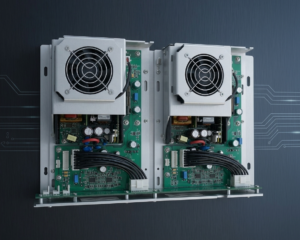
The unit also had to occupy a defined space within an existing cabinet, which made the mechanical design as demanding as the electrical. The chassis, the arrangement of the two power sections, the connector positions and the internal airflow were all resolved around the envelope available. This is routine work for Powerstax.
The unit was CE marked against the applicable EMC, low voltage and radio equipment directives. Since a radar receiver is deliberately sensitive, and a switched mode supply sharing its cabinet is a credible source of conducted and radiated interference, compliance in that setting is not an administrative formality. It determines whether the surrounding equipment performs to specification.
Powerstax designs and manufactures at our own facility in Essex. We also plan for equipment of this kind to remain in service considerably longer than its components will remain available. Radar, defence and infrastructure programmes routinely run for decades, while semiconductors and magnetics are withdrawn from production on a far shorter cycle. We manage obsolescence by redesigning where necessary to preserve form, fit and function, so that the replacement occupies the same space, presents the same interfaces and behaves identically.
