
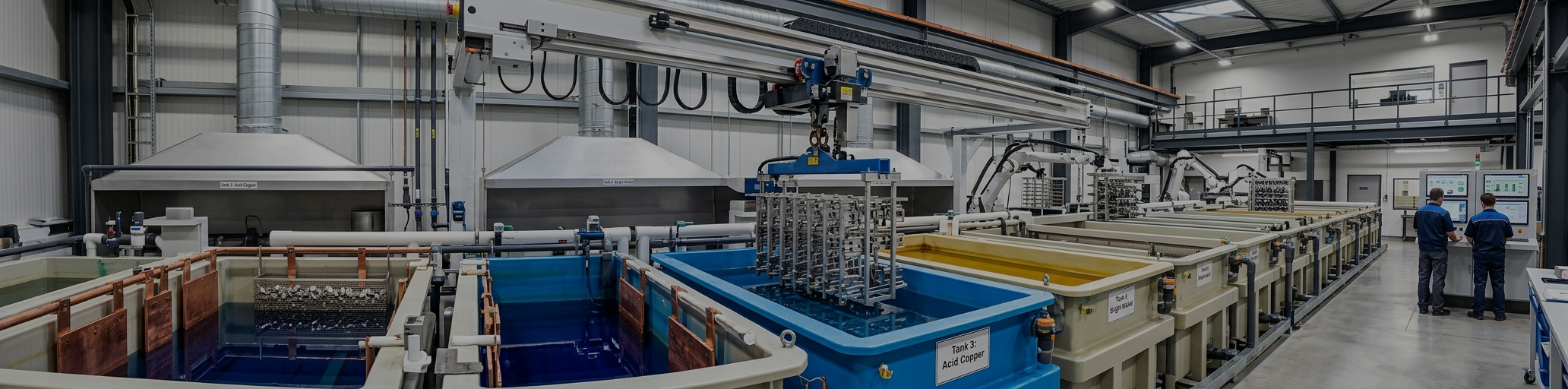
FlexKraft 2
The renowned modular FlexKraft rectifier from KraftPowercon that has been a power horse for electroplaters around the world, has an upgrade.
With increased power density, the new FlexKraft2 takes up less factory space and with increased efficiency, brings your operating costs down.
But that’s not the interesting part.
Each module in the new FlexKraft 2 can be controlled and monitored independently.
This means you can fine tune the current distribution through the tank or power multiple tanks from one rectifier.
So, instead of buying multiple machines, you can combine your requirements and keep valuable factory floor space for something else.
Single module FlexKraft 2 machines offer 2 outputs each giving up to 5000W. And with a 10-module tower, the combined 20 independent outputs deliver a smooth 100,000 watts of power.
Need more juice? Combine 1 master tower with up to 4 slave towers for 500,000 watts of reliable power delivered to your process.
For more information and custom control systems, contact Powerstax, the official UK KraftPowercon service centre and distributor by emailing sales@powerstax.com


Redundant Power for a Radar System
Where equipment cannot be allowed to stop, the power supply ceases to be a supporting component and becomes part of the safety case. Radar is a clear example. These systems underpin the safe management of airspace, and they are expected to continue operating through a fault rather than fail gracefully.
Powerstax equipment is designed for high reliability as standard. This application called for something further: a supply capable of delivering full output after losing half of its own capability.
The solution was a custom rack mounted unit housing two independent power sections within a single chassis. Under normal conditions the two share the load, so neither operates near its limit and both run cooler, with the reduction in thermal and electrical stress translating directly into longer service life. The defining characteristic, however, is the behaviour under fault. Each section is rated to carry the entire system alone rather than half of it, so the loss of one leaves the other to assume the full load with no load shedding, no derating and no interruption apparent to the operator.
Redundancy is worth only as much as the notification accompanying it. A supply that silently loses half its capability has not failed safely; it has simply moved the failure to a later and less convenient moment. Each section of this unit therefore carries its own monitoring circuit, watching its output continuously. Should that output drop, the supply changes the state of a status output and reports the condition to the radar system, which in turn brings it to the attention of the operator. The fault becomes visible the moment it occurs, while the system is still running at full output on the surviving section.
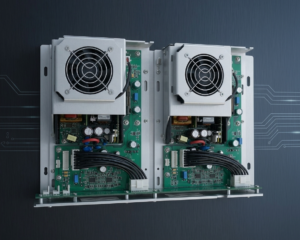
The unit also had to occupy a defined space within an existing cabinet, which made the mechanical design as demanding as the electrical. The chassis, the arrangement of the two power sections, the connector positions and the internal airflow were all resolved around the envelope available. This is routine work for Powerstax.
The unit was CE marked against the applicable EMC, low voltage and radio equipment directives. Since a radar receiver is deliberately sensitive, and a switched mode supply sharing its cabinet is a credible source of conducted and radiated interference, compliance in that setting is not an administrative formality. It determines whether the surrounding equipment performs to specification.
Powerstax designs and manufactures at our own facility in Essex. We also plan for equipment of this kind to remain in service considerably longer than its components will remain available. Radar, defence and infrastructure programmes routinely run for decades, while semiconductors and magnetics are withdrawn from production on a far shorter cycle. We manage obsolescence by redesigning where necessary to preserve form, fit and function, so that the replacement occupies the same space, presents the same interfaces and behaves identically.

Offshore Cathodic Protection (ICCP)
As renewable energy capacity grows, protecting those assets and extending their working life becomes increasingly important. Large offshore metal structures need more than paint and sacrificial anodes alone if they are to withstand long-term exposure to harsh marine conditions.
Working with a corrosion protection specialist, Powerstax helped develop an Impressed Current Cathodic Protection (ICCP) system that now supports the protection of offshore energy infrastructure.
By raising the electrical potential of the surrounding seawater above that of the wind turbine structure, the rate of corrosion is dramatically reduced. This helps extend the life of each turbine and supports lower long-term costs for renewable energy generation.
The system’s PLC continuously monitors the charge in the surrounding water via reference electrode feedback and controls the level of current into the sea as needed.

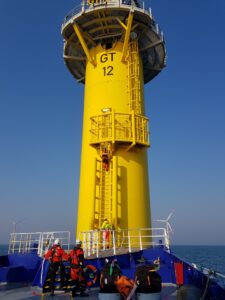
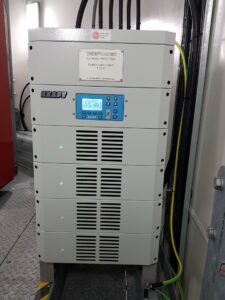
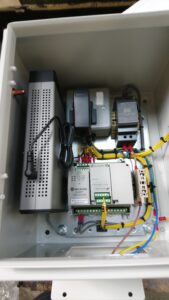
The solution is based on a KraftPowercon rectifier, adapted by Powerstax to meet the specific demands of ICCP. Its modular design also provides the reliability required for continuous protection in a demanding offshore environment.
Because of the installation location, Powerstax built and fully tested the system in-house before carefully dismantling and packing it in sections. With small access hatches offshore and no lifting equipment available, the 200kg system had to be transported by boat, carried up ladders and manoeuvred through tight spaces inside the turbine tower before being reassembled and commissioned on site.
Today, around 33 wind turbine towers generating clean energy benefit from round-the-clock cathodic protection, with Powerstax playing an important part in making that possible.
At Powerstax, we custom build power supplies for ICCP. Whether you need to protect large structures in the sea or smaller structures in the ground, Powerstax can build a PSU for your needs.
Contact Powerstax with your ICCP power requirements to see how we can help protect your assets!